AI-Assisted Design Workflows
Overview
This started as a prompting framework and a custom ChatGPT collaborator built to help designers get consistently useful output from AI across research, design, and writing tasks. It has since evolved into a suite of Claude Skills that encode Sojern's actual design methodologies, conversation design, interview guides, survey design, UX writing, research synthesis, directly into the tools designers use every day. The throughline across both phases is the same: AI is only as useful as the structure you give it, and that structure should live in the tool, not in a document nobody re-reads.
Problem
Designers using AI tools were getting inconsistent results, not because the tools weren't capable, but because prompts were vague or missing key context, so outputs varied wildly and time got lost iterating on bad first attempts. That same root problem showed up again a year later in a different shape: Sojern's design methodologies for conversation design, interviews, surveys, and UX writing all existed as written standards I created, but a standard only helps the person who remembers to go read it. In both cases, quality depended on who was doing the work and whether they happened to already know the guide by heart.
"The problem wasn't the AI, it was the input."
Foundations: The RTCCF Framework
Everything downstream of this project rests on one framework: RTCCF, a five-part structure for writing AI prompts that consistently produce useful, actionable output.
RTCCF came out of looking at how other disciplines, engineering, content strategy, data science, approached prompt structure, and noticing the best results consistently came from prompts that were specific about role, intent, and constraints upfront. It's the reason every skill built later, whether it's reviewing a chatbot script or auditing a survey, follows the same underlying shape: define the role, scope the task, supply context, name the constraints, specify the format.
Phase 1: Custom ChatGPT Collaborator & Prompt Library (2025)
The first application of RTCCF was a custom ChatGPT configured to guide users through the framework before producing any output, asking clarifying questions mapped to missing RTCCF fields rather than making assumptions and running with them. Alongside it, I built a categorised prompt library covering seven core design disciplines, research, design systems, design, writing, synthesising insights, ideation, and user flows, documented in a structured Miro board so prompts could be browsed and reused without being rebuilt from scratch each time.
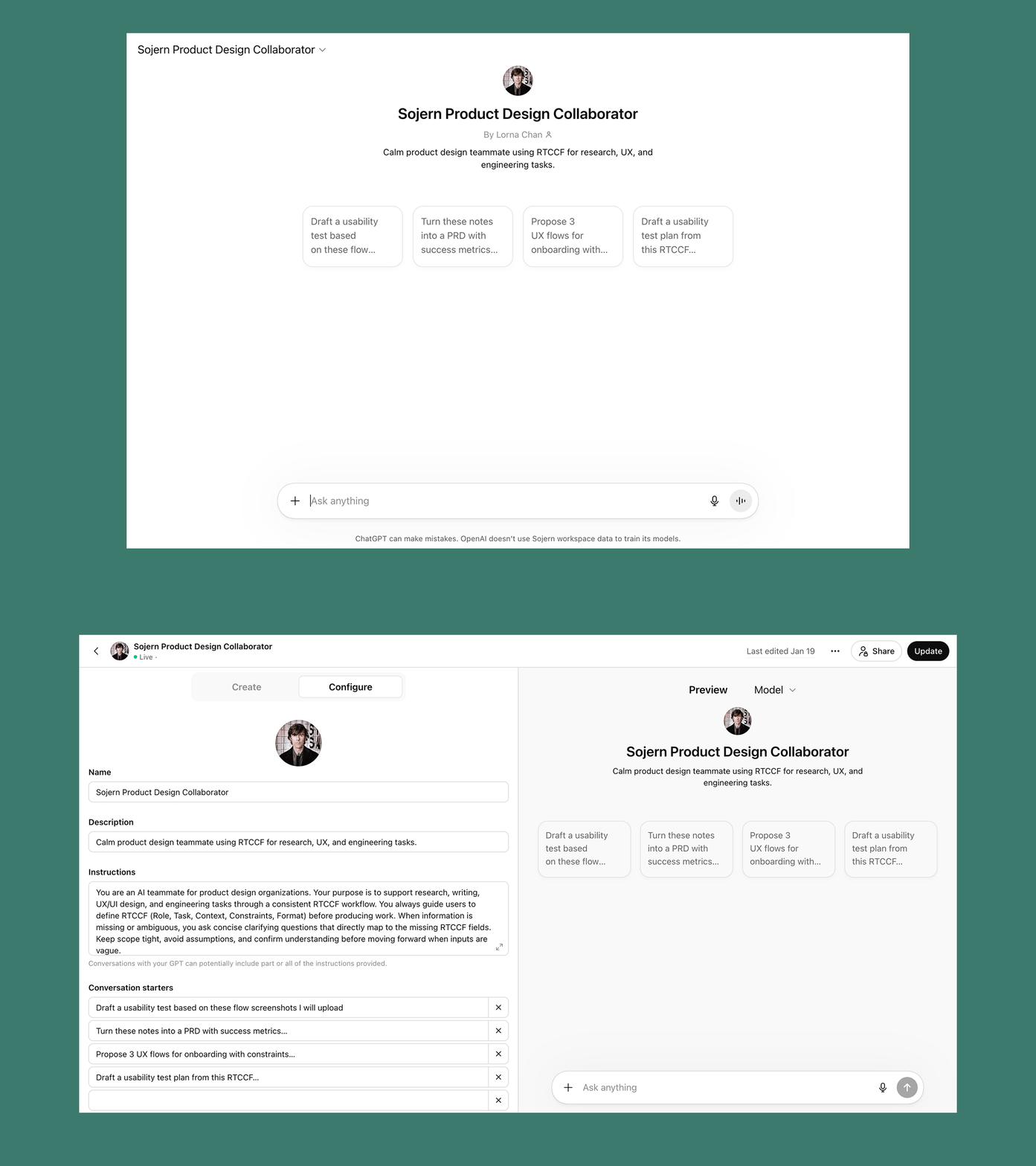
The custom ChatGPT collaborator, configured to guide users through the RTCCF framework before producing any output.
This phase proved the concept: a shared structure, applied consistently, produced faster and more reliable AI output than ad hoc prompting. Its limits were mostly platform limits, everything lived in one chat window, had to be manually invoked, and only covered general design tasks rather than Sojern-specific methodology.
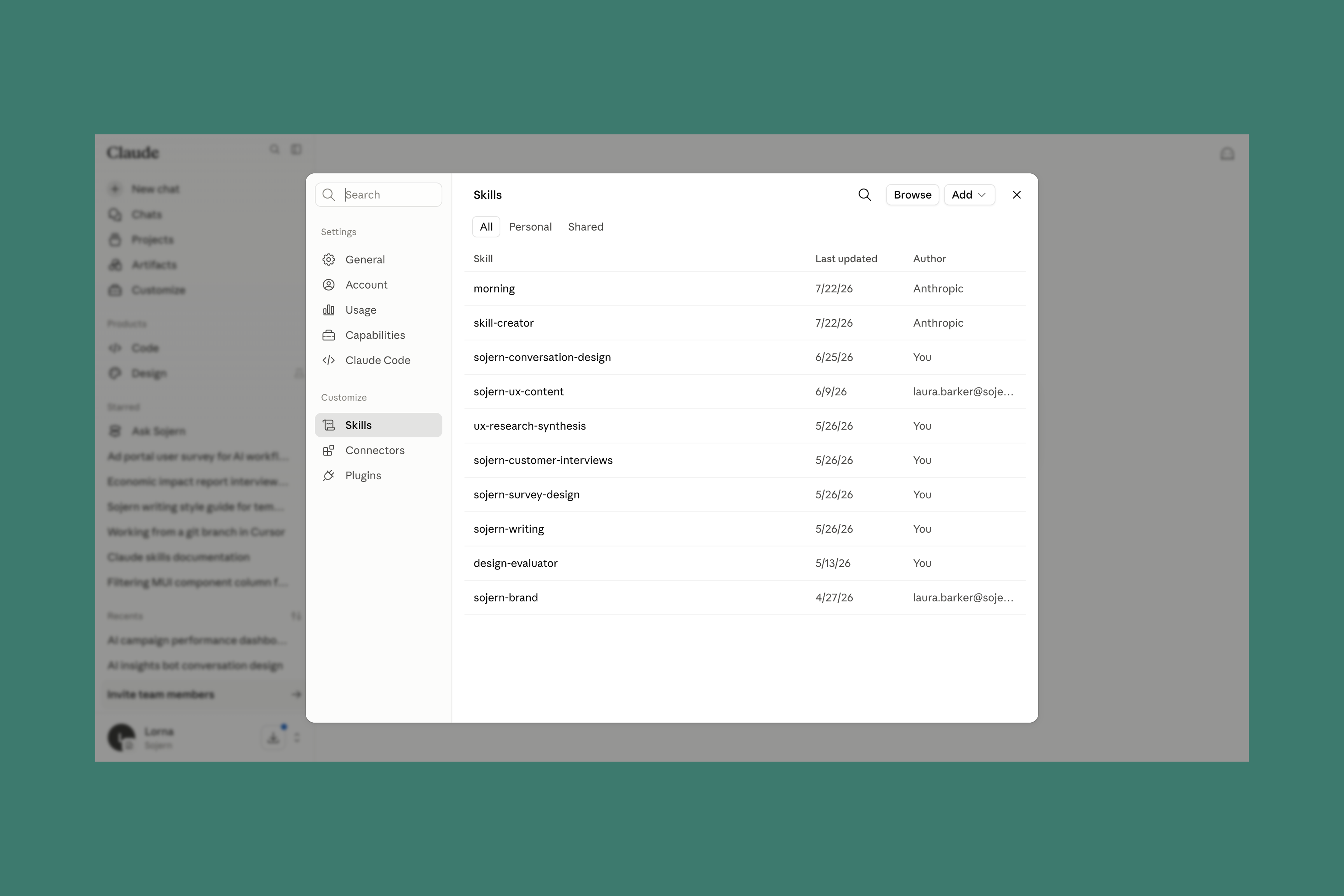
The Skills built for Sojern's design team, live in Claude's Skills settings, shared and used across the team.
Phase 2: Claude Skills (2026)
The natural next step was moving the same idea onto Claude Skills, packaging Sojern's specific design methodologies as reusable, invokable skills rather than general-purpose prompts. Where the ChatGPT collaborator asked a designer to bring their own task into a shared framework, a skill encodes the standard itself, triggering automatically when the task matches, so the guide isn't something you have to remember to consult, it's already there.
Six skills came out of this phase
-
Conversation Design Reviews or writes chatbot and virtual agent dialogue against Sojern's conversation design standards: persona, tone, repair, escalation, rejection handling.
-
Customer Interviews Creates and audits customer interview guides against Sojern's research methodology, catching leading or biased questions before a session happens.
-
Survey Design Designs and reviews surveys against Sojern's survey best practices, including bias checks and conditional logic.
-
UX Content & Writing Applies Sojern's brand voice and UX writing standards to microcopy, emails, help articles, and in-product guides.
-
Research Synthesis Turns raw interview transcripts and research notes into structured themes, insights, and How-Might-We statements.
-
UX Audit Runs a structured usability and accessibility review on a screen, flow, or Figma file, checking hierarchy, clarity, consistency, and WCAG accessibility, and returns a prioritised checklist.
Outcomes
The most significant measurable impact has been time: tasks like drafting usability test scripts, structuring interview guides, and synthesising research, work that previously required a full working session, now comes back in a fraction of the time, an 80% reduction in cases like research synthesis and interview guide drafting. Just as importantly, the quality floor rose across both phases: outputs start from a structured baseline by default instead of depending on whoever's doing the work already knowing the framework or the guide.
Reflection
The biggest lesson didn't show up until these two phases were viewed together. Twelve months ago, a custom GPT was the best available answer; today it's already the earlier, more limited version of the same idea. The ChatGPT collaborator was a good first answer, but it was still a destination you had to remember to visit. Claude Skills close that gap, they trigger on the right task automatically and compose alongside other tools rather than living in a separate chat window, and that's less a permanent solution than the current best answer given how fast the underlying models and platforms are moving. If I were starting over, I'd build the Skills layer first and treat the custom GPT as the prototype it turned out to be, but the bigger habit this project reinforced is not getting attached to any one tool: the job is to keep re-asking what's now possible that wasn't six months ago, and rebuild accordingly.